
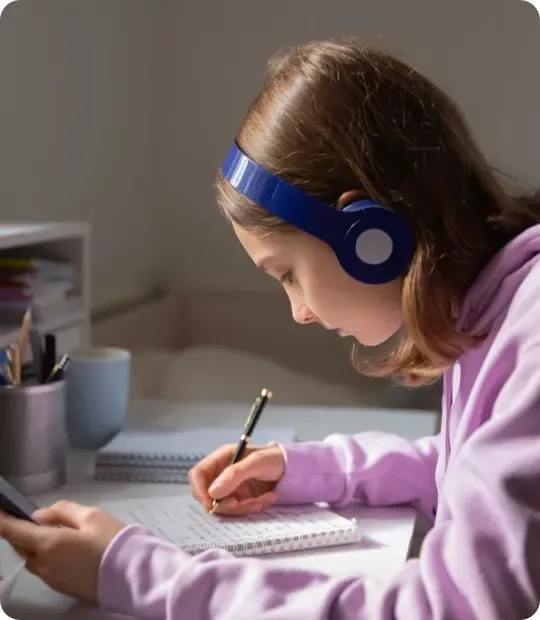
If you are raising children in Toronto, Chicago, London, Zürich, Munich, Milan or Athens and you want them to speak Albanian with their grandparents, this guide is for you. It summarises what researchers actually know about bilingual children and heritage languages, separates the myths from the evidence, and then gets practical: which family strategies have the best track record, why so many diaspora children understand Albanian but will not speak it, and the routines that move a child from nodding along to answering back.
The honest starting point
Most children who grow up abroad end up dominant in the language of the country they live in. That is not a failure of parenting. It is what happens when school, friends, television and the street all run in English, German, Italian or Greek for ten hours a day. The question is not whether your child will be more comfortable in the majority language. They almost certainly will. The question is whether Albanian stays alive as a real, usable language for family life.
The clearest large-scale picture of generational shift comes from the Pew Research Center’s work on Spanish in the United States, which tracked language use across three generations of Latino families. Among immigrants, 61 percent were Spanish-dominant. Among their children, that dropped to 8 percent, with 53 percent bilingual and 40 percent English-dominant. By the third generation, 69 percent were English-dominant and fewer than half (47 percent) said they could carry on a conversation in Spanish. That is for Spanish, a language with tens of millions of speakers in the US, Spanish-language television and schools that teach it. For a smaller language like Albanian, with no media ecosystem in the host country, the pull toward the majority language is stronger, not weaker.
So the realistic goal for most diaspora families is this: a child who can hold a comfortable conversation with gjyshja GJOOSH-yah and gjyshi GJOO-shee, follow what is said at a family table in Tirana or Prishtina, and feel that Albanian is theirs. Reading literature or writing essays can come later if the child wants it. Conversation with family is the foundation, and it is achievable.
The myths: confusion and delay
The two worries parents raise most often are that two languages will confuse a child, and that the child will start talking late. Speech-language professionals have been pushing back on both for years. A 2011 column in The ASHA Leader, the magazine of the American Speech-Language-Hearing Association, describes these as the most common parental questions and gives the short answer: generally, no. An Open University summary of the research, citing Bialystok (2015) among others, puts it plainly: learning two languages does not confuse children or harm their development, and bilingual children develop language on a normal timeline.
What parents often mistake for confusion is code-mixing: a sentence like “Mami, can I have some bukë?” The research treats this as normal and usually temporary. The child reaches for whichever word comes to mind first, which is often the word from the stronger language. It does not mean the child cannot tell the languages apart. Paradis, Genesee and Crago, in the third edition of their handbook Dual Language Development and Disorders, note that mixing is common in bilingual communities worldwide and is “often controversial and poorly understood” precisely because adults read it as a problem when it is not.
The delay worry has a real kernel inside it. Ellen Bialystok, the York University psychologist who has spent decades studying bilingual children in Toronto, has called it “a well-known fact that bilingual children control a smaller vocabulary in each language than their monolingual counterparts.” The key phrase is in each language. A bilingual four-year-old may know fewer English words than an English-only child, but when you count both languages together the totals are comparable. This is why a child’s English vocabulary at nursery can look slightly behind while their overall language development is perfectly healthy. If a child is late in both languages, that is a reason to see a speech-language therapist, and a good therapist will not tell you to drop Albanian.
| Worry | What the evidence says |
|---|---|
| “Two languages will confuse my child” | No. Children separate their languages early; mixing is normal and fades with more input in each language. |
| “Bilingual kids talk late” | No. Milestones are on the normal timeline. Vocabulary is spread across two languages, so each one may look smaller on its own. |
| “We should drop Albanian until English is solid” | Backwards. The majority language will come regardless; the minority language is the one at risk. |
| “Bilingual kids are smarter” | Overstated. Some studies find small advantages in attention and flexibility; a 2020 systematic review found the results inconsistent. |
That last row deserves a word. You may have read that bilingualism makes children better at multitasking or protects against dementia. The evidence for a “bilingual advantage” in children’s executive function is genuinely contested. A 2020 systematic review in Frontiers in Psychology by Giovannoli and colleagues examined the studies using the PRISMA method and concluded that the inconsistent results “do not allow drawing definite conclusions.” Bialystok herself has stressed that bilingual and monolingual children often differ in social class, education and immigration history, and that it is “essential to demonstrate” that the number of languages is the real source of any difference. The honest reason to pass on Albanian is not that it raises IQ. It is that it connects your child to their family and their history, and that is reason enough.
Family strategies: what the numbers actually show
Parenting books tend to present “one parent, one language” (OPOL) as the gold standard: Mum speaks only Albanian, Dad speaks only English, and the child sorts it out. The most useful evidence on whether this works comes from Annick De Houwer’s 2007 study in Applied Psycholinguistics, which surveyed 1,899 families in Flanders where at least one parent spoke a language other than Dutch, each with a child aged six to ten. Every child in the study spoke the majority language. Not every child spoke the minority one.
De Houwer’s headline finding was that OPOL was “neither a necessary nor a sufficient” condition for a child to become bilingual. In the summary François Grosjean gives of the same study, roughly one in four children raised with OPOL did not actively speak the minority language. The pattern that worked best was simpler: both parents using the minority language at home, with at most one of them also speaking the majority language to the child. Barbara Zurer Pearson, reviewing De Houwer’s data alongside a Japanese study by Yamamoto, reports the comparison directly. Minority language at home produced active bilinguals in 79 percent of the Flemish families, against 74 percent for OPOL; in the Japanese sample the figures were 93 and 83 percent. Pearson also highlights that families where the parents spoke the minority language to each other were much more successful.
What this means for an Albanian family abroad:
| Strategy | What it looks like | Evidence |
|---|---|---|
| Minority language at home (mL@H) | Everyone speaks Albanian inside the house; the majority language lives at school and outside | Highest success rate in both surveys |
| One parent, one language (OPOL) | One parent always Albanian, the other always the majority language | Works for most families, but about a quarter of children stay passive |
| Mixed, no rule | Parents switch depending on mood and topic | Weakest; the majority language tends to take over |
The reason mL@H works is not magic. Pearson’s explanation is that it creates a domain where Albanian does not have to compete with English or German for the child’s attention. Inside the house, Albanian is simply what is spoken. OPOL creates a similar domain but with blurrier edges, especially once the child realises that the Albanian-speaking parent also understands English perfectly well.
If one parent does not speak Albanian, OPOL is still a sound plan, and you can strengthen it: the non-Albanian parent can learn enough to follow mealtime conversation, and the Albanian-speaking parent should hold the line consistently rather than sliding into English when tired. Consistency over years matters more than the label on the strategy. If the Albanian-speaking parent is the one who works long hours, that is exactly the family that benefits most from grandparents, cartoons and a weekly lesson filling the gap.
Why kids understand but will not speak
If you ask around any Albanian community abroad, you will hear the same story: “She understands everything, but she answers in English.” This is so common that linguists have a name for it. Silvina Montrul, in The Acquisition of Heritage Languages (Cambridge University Press, 2015), describes heritage speakers as a kind of native speaker whose development is uneven across different parts of the language. Their listening and pronunciation often reach native-like levels because they heard the language from birth. Vocabulary shrinks compared with the first generation. Grammar shows the wear of limited use: inconsistent gender agreement, regularised plurals, trouble with complex sentences. Montrul’s explanation is input: heritage speakers simply do not get enough of the language, and much of what they get comes from a small circle of relatives rather than from school, peers and books.
The step from understanding to speaking is the hardest one, and it rarely happens on its own. A child who can get everything they need by answering in English will answer in English. That is not stubbornness; it is efficiency. The job of the parent is to make Albanian the path of least resistance for at least part of the day.
Three things move children toward active speech:
Real need. The single most powerful lever is a person the child loves who genuinely cannot follow English. For most diaspora families, that person is a grandparent. A weekly video call where Gjyshja asks “Çfarë bëre sot?” CHFAHR BEH-reh soht (What did you do today?) and waits for an answer does more than any app.
Gentle insistence. When a child answers in English, parents who have succeeded tend not to lecture. They repeat the question in Albanian, or model the Albanian answer and have the child say it back: “Dua ujë” DOO-ah OO-yuh (I want water). The Open University summary notes that pressure and constant correction slow learning more than bilingualism does, so the tone matters. Think of it as a game with rules the child knows, not a test.
Peers and trips. Paradis, Genesee and Crago’s handbook profiles a Bulgarian-English child and notes that varied interactions, especially with same-age peers, and trips to the home country make retention far more likely. Two weeks in Albania or Kosovo with cousins can accomplish what a year of good intentions cannot, because for those two weeks Albanian is the language of play.
Routines that fit a real family week
Most parents abroad do not have the time or energy for a full home-school programme, and they do not need one. What works is small, consistent, and attached to things that already happen.
A daily 15-minute Albanian window. Pick a fixed point: breakfast, the walk to school, bath time, bedtime. During that window, only Albanian. Fifteen minutes a day is more than ninety hours a year, delivered at an age when children absorb language fastest. Narrate what you are doing. “Tani lajmë duart” TAH-nee LAH-yum DOO-art (Now we wash our hands). Ask questions that require more than po or jo.
Grandparents on video calls, with a plan. Open-ended calls tend to collapse into “Si je? Mirë. Mirupafshim.” Give the grandparent a job: read a short picture book over the call, teach one song a week, ask the child to show and name three toys. Short and regular beats long and rare.
Albanian cartoons, songs and audiobooks. Children’s content in Albanian is easier to find than it was ten years ago. Screen time in Albanian is not a substitute for conversation, because cartoons do not wait for an answer, but it keeps the ear tuned and feeds vocabulary. Songs are especially effective because children will sing lines they would never say.
Reading aloud. Even if you learned to read Albanian only as a child yourself, reading simple picture books aloud gives your child access to words that never come up in kitchen conversation. If your Albanian spelling is rusty, choose books with short text and read slowly; the ë and ç are reliable once you trust them.
Trips home. Save for them, plan them around cousins and neighbourhood children rather than monuments, and leave the tablet at home. Children who arrive silent on day one are often chattering by day ten.
Albanian-speaking playdates and community events. Where there is an Albanian community, use it. Where there is not, two families meeting once a fortnight is enough to show your child that Albanian is spoken by people other than you.
Where a weekly lesson fits
Montrul’s book makes a point that parents often overlook: schooling in the heritage language is one of the conditions that supports native-like ability, and explicit instruction, with attention to form and gentle correction, is what shores up the grammar and vocabulary that casual home use leaves shaky. Home gives the child the ear and the feeling for the language. A lesson gives structure, new vocabulary beyond the household, and a patient adult whose whole job is to get the child talking.
That is why we built our children’s programme around one-on-one lessons rather than large group classes. A certified teacher in Albania works with your child for an hour a week, in standard Albanian, at the child’s level, and the lesson is almost entirely spoken. For a child who understands but will not speak, that hour is often the first place they produce full sentences, simply because the teacher does not speak English back. Teenagers and adults who grew up with the language and want to fill the gaps are better served by our heritage speaker track, which starts from what they already know rather than from zero.
A lesson on its own, with no Albanian at home, will not produce a fluent child. Home use on its own very often produces a child who understands and does not speak. Together they reinforce each other: the lesson gives the child words and confidence, and the home gives them a reason to use them.
A note from Meti
I started LearnAlbanian in Toronto because of my own two daughters. Their grandparents are in Albania, and I watched the oldest reach the point where she could follow everything on a video call but answered in English, and I saw how much that quietly hurt my parents. We did not fix it with one clever trick. We made Albanian the language of dinner, we gave my mother a book to read to the girls on Sundays, we went home for a summer, and we added a weekly lesson so that someone other than their parents was expecting them to speak. They are still more comfortable in English, and they probably always will be. But they can sit at my parents’ table and talk, and that was the goal.
Next step
If you want to know where your child stands and what a realistic plan looks like for your family, book a free one-hour assessment. A teacher will talk with your child in Albanian, tell you honestly what they can already do, and suggest a routine that fits your week.